
solution · source-backed review
AC Foaming: Match the Grade to the Process
Evaluate SA grade, particle size and gas-release behaviour alongside melting, cure, residence time and cell requirements.
Discuss this requirement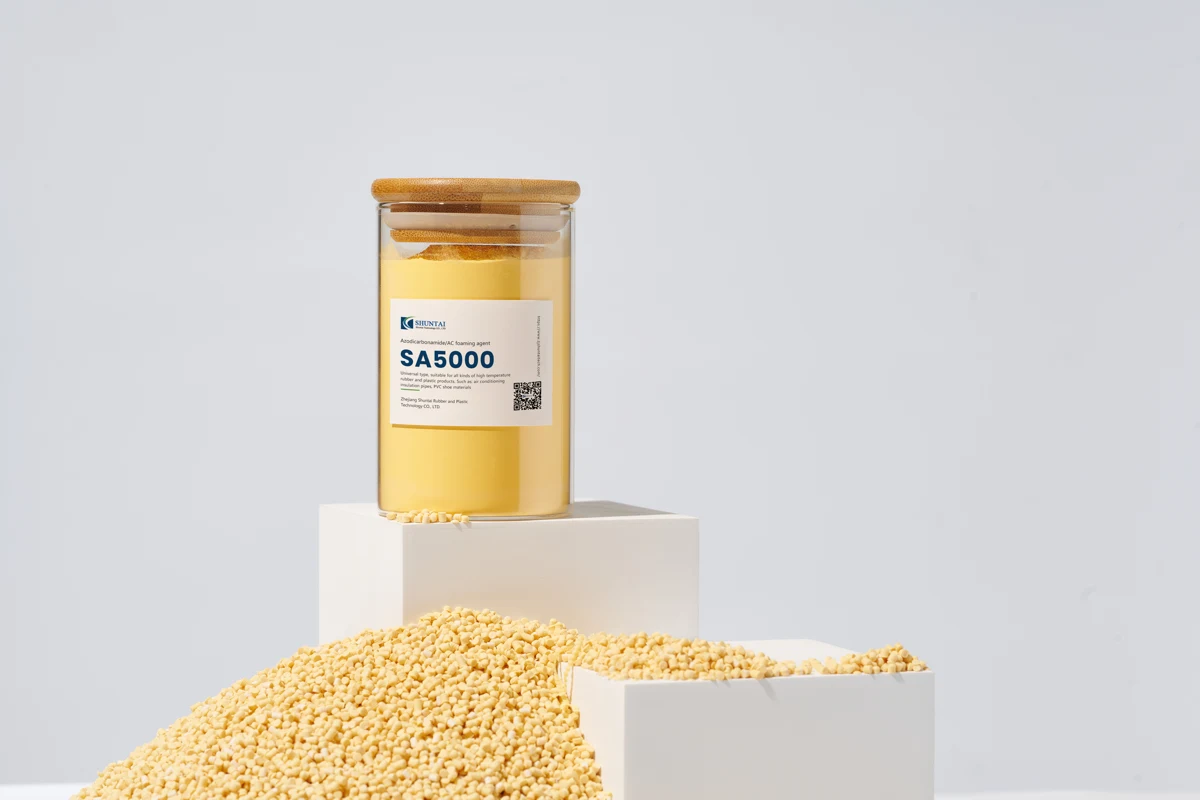
- Approach
- Material and process together
- Validation
- Controlled comparison
- Boundary
- No guaranteed outcome
From expansion to controlled cells
The supplied AC solution identifies AC/ADCA routes for PVC, EVA, PE, PP, rubber and selected thermoplastic systems. The application determines which grade and process window to evaluate; theoretical gas yield alone is not a sufficient selection rule.
Why a high gas yield may still produce a poor result
- Release before sufficient melt strength or cure may allow gas escape, coarse cells, surface defects or low expansion.
- Release too late may lead to incomplete foaming, high density, residue or later dimensional change.
- Dispersion, part thickness, heating history and cooling may change the result even with the same grade.
Application-specific evaluation priorities
| Application | What to evaluate |
|---|---|
| PVC leather, wallpaper and floor/wall materials | Foam height, surface, pinholes, whiteness, yellowing, hand feel and odour. |
| EVA footwear and foam | Expansion, cells, shrinkage, hardness, rebound and odour; include EVA grade and crosslinking. |
| PE/XPE/IXPE | Closed cells, crosslinking, expansion direction, dimensions and tensile properties. |
| Rubber and seals | Mooney viscosity, cure system, extrusion speed, target density and cure/gas timing. |
| PE cable insulation | Dispersion, activation, pressure, line speed, eccentricity, surface and dielectric properties. |
| Injection/extrusion | Material grade, wall thickness, mould, screw, back pressure, filling, holding and cooling. |
Actual temperature and retention time
Equipment setpoint is not actual material temperature. Local shear, die temperature, mould heating rate and residence time affect decomposition. For cure or crosslinking systems, track when the material gains and retains sufficient gas-holding strength.
SA series directions from the application document
| Grade | Source-described selection direction |
|---|---|
| SA1000 | High-expansion/general processing candidate; evaluate the actual material. |
| SA3000 | Balance foaming, dispersion, surface and processing stability. |
| SA5000 | Evaluate expansion, uniform cells and appearance for foam and continuous processing. |
| SA6000 | Fine-cell, surface, whiteness and uniformity direction. |
| SA7000 | Finer dispersion/cell and surface requirements. |
The PVC passage also identifies SPE and SJ160 for evaluating modified temperature/release behaviour. In rubber, compare AC with OBSH, TSH or a modified route where justified. Masterbatch routes may be evaluated for metering and dispersion.
Pending confirmation The current sales master, model-specific numerical TDS and test definitions are not supplied for this series. These are candidate directions, not approved grade specifications.
Four selection questions
- What is the actual material temperature and thermal history?
- When does the resin melt or the rubber cure enough to retain gas?
- Which cells, colour, surface and dimensions are acceptable?
- Which odour, formamide/VOC, destination-market and finished-part test requirements apply?
Use controlled comparisons
- A · Baseline. Current compound, agent, dose and process, with the current result recorded.
- B · Direct replacement. Change the candidate agent while holding other conditions steady.
- C · Process optimisation. Evaluate permitted adjustments to actual temperature, time, speed, pressure and cooling.
- D · Alternative. Compare a second candidate or a reviewed compound route.
For each group record model, batch, dose, mixing order, equipment settings, actual material temperature, pressure, speed, residence time, mould/die, cooling and sample time.
Validate the relevant material and finished part
| Evaluation | Record |
|---|---|
| Foaming | Apparent density, part weight, expansion and thickness. |
| Cells | Size distribution, open/closed cells, merging, breakage and skin. |
| Dimensions | Appearance, shrinkage and immediate / 24-hour / 7-day / 28-day change, where appropriate. |
| Mechanics | Hardness, rebound, tensile/tear and compression properties required by the customer. |
| Chemical requirements | Odour, VOC, ammonia and formamide are distinct tests; use the specified methods. |
Pending confirmation No customer-specific baseline, trial results or project report has been supplied. This table is a proposed recording framework, not a results claim.
Keep the result attached to its conditions
A successful small trial does not establish stable production performance. Recheck batches, actual equipment temperatures, mixing and feeding, speed, pressure, residence time, mould/die condition, cooling and ageing during the production trial.
Technical advice does not replace the customer’s formulation responsibility, production verification, finished-product testing or target-market requirements.
Define the next AC trial
Share the exact resin/rubber, process, actual material temperature, residence time, current grade and dose, density and cells, odour/chemical requirements and acceptance criteria.
Discuss AC process matching