
solution · source-backed review
PP/PE Injection and Extrusion Lightweighting
Compare part weight and cell structure while retaining the required surface, dimensions and mechanical properties.
Discuss this requirement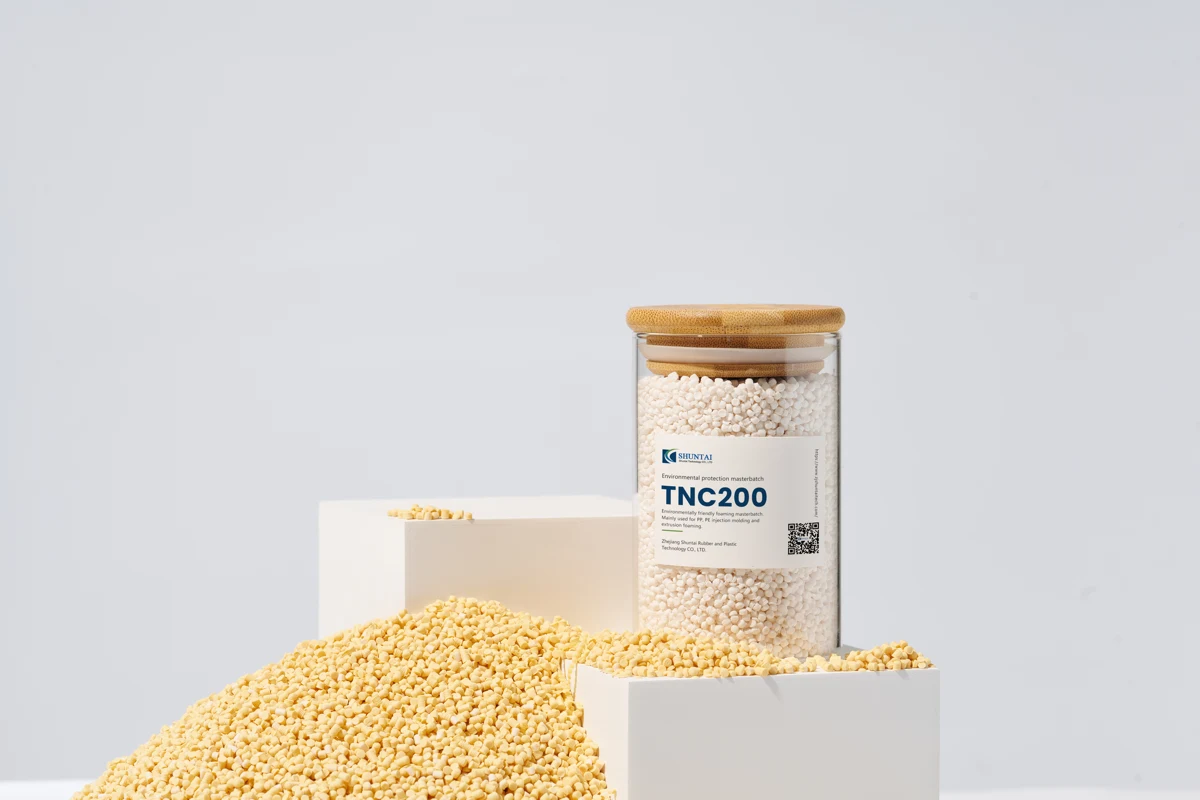
- Approach
- Material and process together
- Validation
- Controlled comparison
- Boundary
- No guaranteed outcome
Define both the saving and what must be retained
The supplied solution covers selected PP, PE and TPR/TPE moulded or extruded components, including non-load-bearing automotive parts, appliance housings/bases, crates, pallets, containers, daily-use goods and PE boards/profiles/pipes. The actual design and acceptance requirements determine suitability.
Visible and internal defects matter together
- Sink marks remaining despite increased holding pressure.
- Silver streaks, flow marks or rough surfaces after foaming.
- Coarse cells, merging or internal voids.
- Warpage, shrinkage or dimensional variation.
- Difficult powder metering, dust or uneven dispersion.
- Different results between equipment/moulds at the same dose.
- Extruded board streaks, unstable skin or thickness variation.
Information before a microfoaming trial
- PP/PE/TPR grade and melt-flow properties.
- Fillers, reinforcement and recycled material.
- Injection/extrusion actual temperature, screw speed, back pressure and residence time.
- Wall thickness, runner and gate.
- Current part weight, target saving and required appearance, dimensions and mechanical limits.
Timing and melt strength set the boundary
Early release may produce silver streaks, incomplete filling or poor surfaces; late release may leave insufficient reduction, residue or later deformation. Excess reduction may compromise impact strength and dimensional stability.
For extrusion, monitor die-region pressure, actual temperature, line speed, cooling, skin formation and melt strength. Fast release may break the surface and insufficient melt strength may collapse cells.
Three distinct technical objectives
| Objective | Source-described route |
|---|---|
| PP/PE injection lightweighting | Evaluate an appropriate TNC carrier, active fraction, start/release behaviour and dispersion against the resin, mould and target. |
| Sink compensation / dimensions | Consider an endothermic masterbatch or a lower addition level; adjust holding, back pressure, injection speed, mould temperature and cooling. |
| PE extrusion board/profile foam | Evaluate NC-6/NC, suitable TNC or an AC/NC compound route against temperature and melt strength. |
Pending confirmation The source lists TNC200/211/212/300/308 as candidates. Current availability, carrier and exact model parameters are not verified; no additional SKU detail is created from that list.
A sink-mark project is not necessarily a high-expansion project
For sink compensation, the aim may be limited gas generation to offset volume shrinkage rather than a high expansion ratio. For lightweighting, state which surface, impact, assembly and dimensional properties must be retained alongside the weight target.
Compare dose and process under controlled conditions
- A · Baseline. Current compound, agent, dose and process, with the current result recorded.
- B · Direct replacement. Change the candidate agent while holding other conditions steady.
- C · Process optimisation. Evaluate permitted adjustments to actual temperature, time, speed, pressure and cooling.
- D · Alternative. Compare a second candidate or a reviewed compound route.
For each group record model, batch, dose, mixing order, equipment settings, actual material temperature, pressure, speed, residence time, mould/die, cooling and sample time.
Include dose gradients and permitted adjustments to pressure, temperature, screw/line speed and cooling. Keep material, mould/die and sampling conditions traceable.
Record weight, appearance, structure and stability
| Area | Source evaluation items |
|---|---|
| Lightweighting | Part weight, apparent density, relative weight reduction and material use. |
| Appearance/dimensions | Streaks, roughness, sinks, warpage, length/width/thickness/roundness and demoulding/24-hour/7-day changes. |
| Structure/performance | Cell size/distribution, skin thickness, voids, tensile/flexural/impact, assembly/drop and long-term requirements. |
| Process | Filling/melt pressure, cycle, mould deposits/cleaning frequency, dispersion and continuous variation. |
Pending confirmation No fixed weight-reduction percentage or unchanged-mechanics guarantee is supported. Actual trial data are required.
A production window must be verified
A successful small trial does not establish stable production performance. Recheck batches, actual equipment temperatures, mixing and feeding, speed, pressure, residence time, mould/die condition, cooling and ageing during the production trial.
Technical advice does not replace the customer’s formulation responsibility, production verification, finished-product testing or target-market requirements.
Start with the resin and part
Share resin grade/MFI, filler content, equipment, actual material temperature, wall thickness, current weight, target saving, defects and mandatory mechanical limits.
Discuss a lightweighting trial